



Chicago Waymo Accident Lawyer
Waymo's self-driving vehicles are now on Chicago roads. In early 2026, the Alphabet subsidiary began testing and mapping its autonomous vehicles across downtown Chicago, from the South Loop to Wrigleyville. While the cars currently operate with human safety drivers, Illinois lawmakers are actively considering legislation that would allow fully driverless operations in Cook County and beyond. For anyone injured in an accident involving a Waymo vehicle, the legal landscape is fundamentally different from a traditional car accident in Chicago.
Autonomous vehicle accidents raise questions that simply do not arise in collisions between two human-driven cars. Who bears responsibility when software makes a mistake? What happens when a sensor fails to detect a pedestrian, a cyclist, or a motorcyclist? And how does a crash victim obtain the vehicle's internal data logs before they are overwritten or withheld?
Briskman Briskman & Greenberg helps people injured by autonomous vehicles navigate these complex claims. Our attorneys understand how self-driving technology works, how liability shifts from driver to manufacturer, and how to preserve the digital evidence that can make or break an AV accident case.
Briskman Briskman & Greenberg Personal Injury & Car Accident Lawyers's Top-Rated Waymo Accident Lawyers Get Results
$717K
Personal Injury Settlement
$875K
Car Accident Injury Involving Pedestrian
$2.01Million
Premises Liability
$1.9 Million
Accident Injury
$900K
Serious Car Accident
Waymo in Chicago: What You Need to Know
Waymo started mapping Chicago's roads in February 2026. The company deployed a limited fleet of its autonomous vehicles east of I-90 with human safety drivers behind the wheel. These initial operations focus on recording geographical data and understanding the city's unique driving conditions, including heavy congestion, aggressive lane changes, and winter weather.
Waymo is a subsidiary of Alphabet Inc., the parent company of Google. It currently operates fully driverless ride-hailing services in five states: Arizona, California, Florida, Georgia, and Texas. As of late 2025, the company reported logging more than 170 million fully autonomous miles nationwide and completing over four million miles of driving per week across its fleet.
Illinois does not yet have a law authorizing fully driverless vehicles. In January 2026, State Rep. Kam Buckner introduced the Autonomous Vehicle Pilot Project Act, which would open counties with more than one million residents, including Cook County, to a three-year pilot program for autonomous commercial vehicles. The bill has been held up in the Rules Committee and faces significant opposition from labor unions, trial lawyers, and motorcyclist safety organizations.
Until legislation passes, Waymo's vehicles in Chicago must have a licensed human driver at the wheel. But even during this testing and mapping phase, accidents can happen, and the legal questions surrounding liability are no less complicated than they would be with a fully autonomous robotaxi.
Waymo's National Safety Record
Chicago & Nationwide News Outlets Turn to Briskman Briskaman & Greenberg When They Need Insights from a Trusted Waymo Accident Lawyer








What Waymo's Safety Record Means for Chicago Passengers
Waymo promotes its safety record aggressively, but the full picture is more complicated. Between July 2021 and November 2025, the National Highway Traffic Safety Administration received reports of 1,429 accidents involving Waymo vehicles across all operating cities. Those incidents produced 117 reported injuries, four crashes classified at the highest injury severity levels, and two fatalities.
Waymo points out that many of these collisions were caused by other drivers rather than by the autonomous system itself. The company's own data claims its vehicles are involved in up to 92% fewer crashes causing serious injuries compared to human-driven vehicles covering the same routes. Peer-reviewed research published in 2025 found statistically significant reductions in injury-causing crashes at the aggregate level, including a 96% reduction in intersection crashes with reported injuries.
But reduced rates are not zero rates. The company is under multiple federal investigations, including probes by both NHTSA and the National Transportation Safety Board. Waymo vehicles have been documented illegally passing school buses with flashing red lights, with the Austin school district alone recording at least 20 such incidents during the 2025-2026 school year. In January 2026, a Waymo vehicle struck a child near an elementary school in Santa Monica. And Waymo vehicles have repeatedly blocked emergency responders, including during an active mass shooting response in Austin.
When a Waymo vehicle is involved in a crash in Chicago, the injured person faces challenges that go far beyond a typical insurance claim. The vehicle's sensor data, software decision logs, and internal camera footage are controlled entirely by Waymo, a company with the resources and legal infrastructure to protect that information aggressively.
Who Is Liable in a Chicago Waymo Accident?
Traditional car accident cases assign fault to one or more human drivers. Waymo accidents break that model entirely. In a fully autonomous crash, the vehicle itself made every decision, which means liability can flow to the company that designed the software, the company that manufactured the sensors, the company that maintained the vehicle, or all three at once.
Waymo (Alphabet Inc.) is the most likely defendant in a driverless vehicle accident. As the developer of the autonomous driving system, Waymo can be held liable when a software flaw, sensor malfunction, or programming error contributed to the crash. This includes failures in object recognition, failures to predict human behavior, and situations where the vehicle's decision-making algorithm chose a course of action that a reasonable human driver would not have chosen.
Vehicle and component manufacturers may share liability in certain cases. Waymo currently uses the Jaguar I-PACE as its primary vehicle platform. If a mechanical component like the braking system or steering failed independently of the autonomous software, the vehicle manufacturer could bear responsibility under Illinois product liability law.
During the current testing phase in Chicago, Waymo's human safety drivers add another dimension. If a safety driver failed to intervene when the autonomous system made an error, or if the driver was distracted or inattentive at the time of the crash, both the driver and Waymo as the employer could face liability. This is similar in structure to other employer-employee negligence claims, but the technical evidence needed to prove the case is far more specialized.
The president of the Illinois Trial Lawyers Association has publicly raised concerns that current AV legislation in Springfield does not adequately address financial responsibility requirements. Minimum insurance coverage for autonomous vehicles should be far higher than for individual human drivers, given the resources of the companies deploying them. If you are injured by a Waymo vehicle, the question of insurance coverage will be a critical factor in your case, and it is one that an experienced personal injury attorney can help you navigate.
Our Top-Rated Waymo Accident Attorneys

From the moment I contacted this firm I was treated like family. I strongly recommend these attorneys.
- RG




Stages Involved in Waymo Insurance Coverage
While Waymo carries commercial insurance for its autonomous fleet, the coverage landscape for crash victims is far more complex than a standard auto policy. Unlike a traditional rideshare service like Uber or Lyft where a human driver's personal insurance may also apply, Waymo accidents involve a single corporate operator, and the availability of coverage depends on the vehicle's operational status at the time of the crash. A Waymo vehicle may be actively carrying a passenger, driving empty to pick someone up, or operating in a testing and mapping mode with a human safety driver behind the wheel. Each of these phases can affect which policy applies, what coverage limits are in play, and how aggressively Waymo's legal team contests the claim.
Types of Waymo Accidents in Chicago
Intersection collisions are the most common type of crash involving Waymo vehicles nationally. Autonomous vehicles rely on cameras, lidar, and radar to identify cross traffic, turning vehicles, and pedestrians at intersections. When the system misreads a traffic signal, misjudges the speed of an oncoming vehicle, or fails to yield, the result can be a broadside or T-bone collision with devastating consequences for the occupants of the other vehicle.
Pedestrian and cyclist accidents represent a particularly serious category of concern. Waymo's own data shows its vehicles achieve significant reductions in pedestrian and cyclist crashes compared to human drivers, but those reductions are not absolute. A child was struck near a school in January 2026. Nationally, Waymo vehicles have also been involved in incidents with cyclists and pedestrians who are inherently more vulnerable than vehicle occupants. One of our Chicago bike accident attorneys can help if you're struck by a Waymo vehicle while cycling.
Rear-end collisions occur when Waymo vehicles brake unexpectedly or come to sudden stops in traffic. Multiple NHTSA reports describe scenarios in which a Waymo vehicle stopped or slowed abruptly, leaving following vehicles with insufficient time to react. In December 2025, Waymo robotaxis came to unexpected stops during a power outage in San Francisco, creating traffic hazards.
Accidents involving emergency vehicles have drawn national attention. Waymo vehicles have been documented blocking ambulances and fire trucks, including during an active emergency in Austin. For accident victims who rely on rapid emergency response, a delay caused by an autonomous vehicle blocking the road can directly worsen the severity of their injuries.
Winter weather accidents are a particular concern for Chicago. Waymo currently operates primarily in warm-weather cities. Icy roads, reduced visibility, obscured lane markings, and heavy snowfall present challenges that the system has not been extensively tested against in a commercial ride-hailing environment. While Waymo says it has conducted winter testing in Detroit, Buffalo, and New York City, those testing programs are not equivalent to full commercial deployment on Chicago roads during a January ice storm.
Common Injuries in Autonomous Vehicle Accidents

The injuries sustained in Waymo accidents are the same injuries that occur in any serious car accident, but the claims process is fundamentally different. Victims may suffer whiplash and soft tissue injuries, traumatic brain injuries, spinal cord damage, broken bones, and internal bleeding. Pedestrians and cyclists struck by autonomous vehicles frequently sustain the most severe injuries because they lack the protection of a vehicle frame.
Delayed symptoms are common after autonomous vehicle accidents. Adrenaline can mask pain for hours or even days after a collision. Concussions, internal injuries, and herniated discs may not present obvious symptoms at the scene. Medical documentation beginning immediately after the crash is essential, both for the victim's health and for the strength of their legal claim.
In cases involving serious or catastrophic injuries, the stakes of the liability determination are enormous. Medical bills for a traumatic brain injury can exceed a million dollars over a lifetime. Neck and back injuries may require surgery and years of rehabilitation. When the at-fault party is a multinational technology company rather than an individual driver, the claims process requires attorneys who understand both personal injury law and the technical dimensions of autonomous driving systems.
Call a Waymo Accident Lawyer Today
A Waymo car accident lawyer is available for a free consultation.
Call 1.872.309.3566
What to Do After a Waymo Accident in Chicago
Why Chicago Presents Unique Risks for Autonomous Vehicles
Chicago's driving environment is unlike anything Waymo has faced at commercial scale. The company currently operates ride-hailing services exclusively in warm-weather cities. Arizona, California, Florida, Georgia, and Texas do not contend with the snow, ice, and extreme cold that define a Chicago winter.
Winter weather poses direct challenges to autonomous driving systems. Lidar sensors can be obscured by snow and ice buildup. Cameras lose effectiveness in low-visibility conditions. Lane markings, which autonomous vehicles rely on for positioning, are frequently hidden under snow or degraded by salt and plowing. The director of the Urban Transportation Center at UIC has raised concerns about whether autonomous systems can function safely on roads where lane markings are not visible to the naked eye.
Chicago's road infrastructure adds further complexity. The city's dense grid, aggressive driving culture, frequent construction zones, and high volumes of pedestrian and bicycle traffic create a demanding environment for any driver, human or machine. Motorcyclist safety organizations have voiced strong concerns that AV sensor arrays may not reliably detect smaller vehicles in mixed traffic.
The legal framework is also evolving in real time. Illinois has no comprehensive autonomous vehicle law on the books. The Autonomous Vehicle Pilot Project Act remains stalled in committee, and the state's existing motor vehicle code was written for human drivers. If you are injured by a Waymo vehicle during this regulatory gap, your case will require attorneys who can identify every available legal theory, from product liability to common-law negligence, and hold the right parties accountable.
Proving Your Case Against Waymo
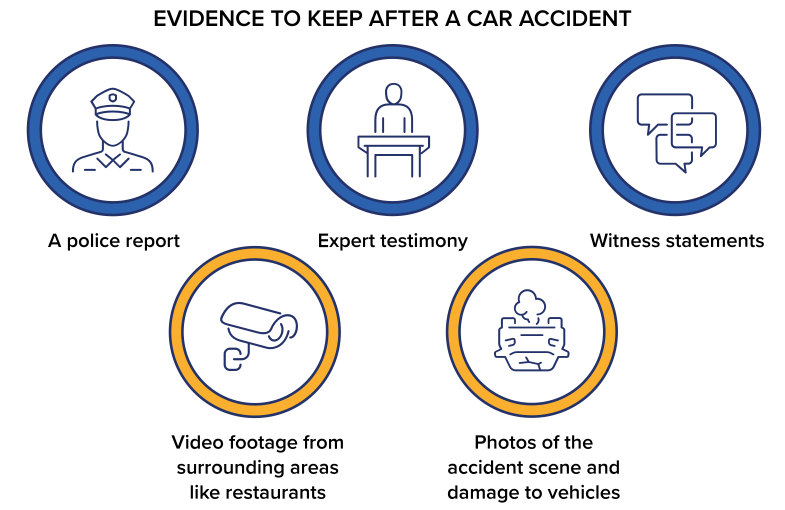
Autonomous car accident cases are built on evidence that does not exist in a typical car accident. A traditional crash might be reconstructed from skid marks, witness testimony, and dashboard camera footage. A Waymo accident requires access to the vehicle's internal data: its sensor readings in the seconds before impact, the decisions its software made, the objects it detected and failed to detect, and the alternative actions it could have taken.
This data is proprietary. Waymo treats its autonomous driving software as a trade secret and will resist disclosure at every stage of litigation. Obtaining it requires aggressive discovery, expert analysis, and, in many cases, court orders compelling production. The NHTSA Standing General Order requires reporting of certain crashes, but the details in those public filings are limited and do not include the granular sensor data needed to prove fault at trial.
Product liability theories are particularly important in Waymo cases. Under Illinois law, a manufacturer can be held strictly liable for injuries caused by a defective product. If the autonomous driving system contained a software defect, a sensor calibration error, or a flawed decision-making algorithm, the injured party does not need to prove Waymo was negligent. They need to prove the product was defective and that the defect caused the injury.
Negligence claims may also apply, particularly during the testing phase. If Waymo deployed its vehicles in conditions its system was not adequately prepared for, or if the company failed to implement known safety fixes in a timely manner, the injured party may have a negligence claim. Waymo has issued two voluntary recalls: one in May 2024 for 672 vehicles due to a software issue involving pole-like objects, and another in May 2025 for 1,212 vehicles due to a defect that caused collisions with roadside barriers.
An attorney handling a Waymo case must understand both personal injury litigation and the technical architecture of autonomous driving systems. At Briskman Briskman & Greenberg, our team works with engineers and accident reconstruction specialists who can interpret AV data and translate it into evidence that a jury can understand. We handle accident cases on a contingency basis, which means you pay nothing unless we recover compensation for your injuries.
Compensation Available in Waymo Accident Cases
The damages available in a Waymo accident case are the same categories available in any serious car accident claim, but the amounts at stake are often higher because of the severity of injuries and the financial capacity of the defendant. Victims may seek compensation for current and future medical expenses, lost wages and diminished earning capacity, pain and suffering, emotional distress, and, in cases involving reckless corporate conduct, punitive damages.
Illinois follows a modified comparative negligence system. If you are found to be partially at fault for the accident, your compensation is reduced by your percentage of fault, and you are barred from recovery if your fault exceeds 50%. In AV cases, the defendant may argue that the injured person contributed to the crash by jaywalking, failing to signal, or otherwise acting unpredictably. Strong evidence from the vehicle's own sensors can often refute these claims, which is another reason early evidence preservation is critical.
In wrongful death cases involving autonomous vehicles, the surviving family members may bring a claim for the full value of the decedent's life, including future earnings, loss of companionship, and the grief and suffering of surviving family. These cases carry the highest stakes and demand the most thorough preparation.

Frequently Asked Questions About Chicago Waymo Accidents




SEEN ON: