




You will take a Chicago bike accident lawyer. Not a case screener. A real lawyer with real experience.
Chicago Bicycle Accident Lawyers
Chicago has over 303 miles of protected bike lanes and off-street trails, and cycling is woven into the fabric of daily life here, whether you are commuting to work on Milwaukee Ave, riding the lakefront trail on a weekend, or running errands through a neighborhood that was built before cars existed. The city has spent years and significant money trying to make those roads safer. The data shows it has not been enough.
Between 2022 and 2025, 8,389 cyclists were struck by vehicles on Chicago roads, resulting in 6,248 injuries and 11 deaths. That number climbed every single year. A four-year analysis of City of Chicago crash records conducted by our firm found that bike accidents surged 46.2% over that period, and that nearly 1 in 3 accidents in 2025 involved a driver who struck a cyclist and fled the scene. If you or someone you love has been hurt on a Chicago road, the personal injury attorneys at Briskman Briskman and Greenberg are ready to help you hold the responsible party accountable.
BB&G's CHICAGO BIKE ACCIDENT LAWYERS HAVE RECOVERED MILLIONS
Briskman Get's Results: We've recovered millions of dollars for injured cyclists, and we are here for you, too.
$717K
Injury Settlement
$875K
Pedestrian Accident
$2.01Million
Accident Injury
$1.9 Million
Accident Injury
$900K
Injury from Car Accident
Chicago Bike Accidents Are Rising Every Year, and the Numbers Are Undeniable
Every year since 2022, Chicago has set a new record for bike accidents. What began as a troubling data point has become a pattern that no amount of new bike lanes has managed to reverse. A four-year analysis of City of Chicago crash records conducted in partnership with our firm found 8,389 reported bike accidents between 2022 and 2025, resulting in 6,248 injuries and 11 deaths. The total climbed without interruption: 1,686 in 2022, 1,937 in 2023, 2,301 in 2024, and 2,465 in 2025. A 46.2% surge in four years. You can read the complete findings at our published research page: Chicago Bike Accidents Have Surged 46% Over Four Years.
The steepest single-year jump came between 2023 and 2024, when accidents rose 18.8% in twelve months and hit-and-run accidents surged by 120 incidents in a single year. By 2025, the year-over-year growth had moderated to 7.1%, but at 2,465 total accidents the volume was higher than it had ever been. Injuries tracked exactly the same curve, rising from 1,256 to 1,836 over the four years. For every additional accident added to the count, roughly one additional injury followed. That is not a coincidence. It reflects a cycling environment where the conditions producing accidents are also reliably producing harm.
The one metric moving in the right direction is the per-accident fatality rate. In 2022, cyclists were killed at a rate of 0.24% per reported accident. By 2025 that figure had fallen to 0.08%, a 66.7% improvement. Better emergency response, higher helmet adoption, and some infrastructure improvements may all be contributing factors. But with crash volume up 46%, the absolute number of people being injured keeps climbing regardless of the improved per-accident survival rate. Chicago is not getting safer for cyclists. It is getting better at treating the injured ones.
Original research based on City of Chicago crash records, 2022 through 2025
Chicago Bike Accidents: 2022 Through 2025
Four years of data shows Chicago is getting more dangerous for cyclists.
Research: Briskman Briskman & Greenberg, based on City of Chicago data.
Why Chicago Cyclists Trust Briskman Briskman & Greenberg After a Bike Accident
Riding a bike in Chicago should be a simple, enjoyable way to move through the city. For many people it is. But for the thousands of cyclists struck by vehicles every year, the aftermath of an accident quickly becomes one of the most stressful and confusing experiences of their lives. Injuries that need immediate treatment. A bike that may be totaled. Insurance adjusters calling within hours asking for recorded statements. Bills arriving before you have finished filling out the police report. And underneath all of it, the nagging question of whether what happened to you was your fault, and whether anyone is going to be held accountable.
Briskman Briskman & Greenberg has represented injured cyclists in Chicago for decades. We know how these cases work because we have built them. We know which evidence needs to be preserved within hours of an accident, which insurance policy provisions are most commonly used to deny valid claims, and how Illinois's modified comparative negligence rules can be weaponized by the defense to reduce what you recover. We treat every client like a person, not a case number. We listen to what happened, we investigate thoroughly, and we fight hard for every dollar of compensation you are owed.
Illinois follows a modified comparative fault standard under 735 ILCS 5/2-1116. What this means in practical terms is that you can still recover full compensation as long as you are not found to be more than 50% responsible for the accident. If you are found 20% at fault, your award is reduced by 20%. If you are found 51% at fault, you recover nothing. Insurance companies understand this rule well, and they use it aggressively. They will look for any evidence that you ran a yellow light, did not use a hand signal, or were not wearing visible clothing. The job of an experienced Chicago bicycle accident lawyer is to build the evidence that establishes the driver's negligence clearly enough that these arguments cannot gain traction. There is no fee unless we win. Call us today for a free consultation.
Types of Chicago Bicycle Accidents We Handle
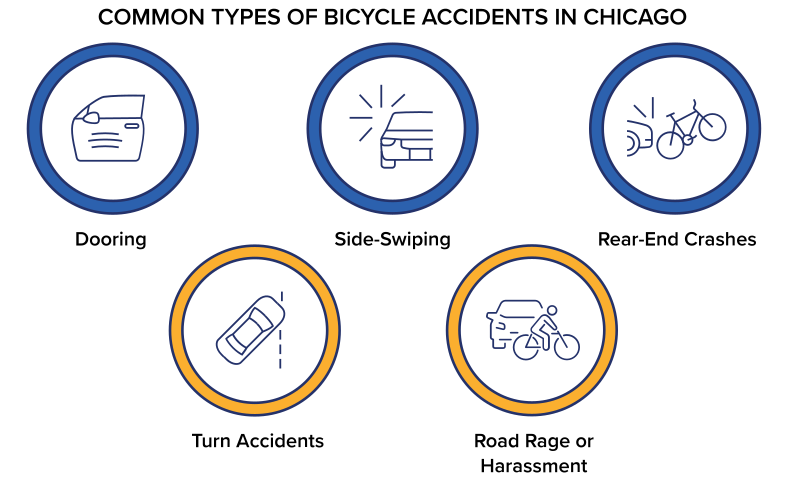
Our Lawyers Handle All Kinds of Bike Accident Injuries
Not all bike accidents happen the same way, and the type of accident often determines who bears legal responsibility, how evidence is gathered, and which insurance policies come into play. Chicago's dense traffic, its mix of protected and unprotected bike infrastructure, and the sheer volume of vehicle types sharing its roads create dozens of distinct accident scenarios every single day. Understanding which type of accident you were involved in is often the first step toward understanding who owes you compensation.
The most common accidents we handle involve direct vehicle-on-bicycle collisions at intersections and along shared road segments. Right hook accidents, where a driver turns right across a cyclist traveling straight in a bike lane, and left hook accidents, where a driver turns left in front of an oncoming cyclist, account for a significant share of serious injury accidents in Chicago. In both cases, the driver typically claims they did not see the cyclist. Our job is to establish that they should have. We also handle Chicago Rear-End Bicycle Accidents and Chicago Sideswipe Bicycle Accidents, as well as the full spectrum of Chicago Bicycle Intersection Accidents that make up the majority of reported incidents in the city.
Dooring accidents are a Chicago-specific hazard that many cyclists experience firsthand. When a driver or passenger opens a car door into a bike lane without checking for approaching cyclists, the impact is sudden and severe. The cyclist has fractions of a second to react, and the force of impact with an open door can throw a rider directly into moving traffic. This is illegal in Chicago under Municipal Code Section 9-80-035, and it is a form of negligence that our attorneys know how to document and prove. Dooring accidents cause a disproportionate share of serious head and spinal injuries because of the abrupt, unexpected nature of the impact. We handle Chicago Dooring Bicycle Accidents, Chicago Bicycle Accidents in the Door Zone, and Chicago Bicycle Accidents Caused by Parked Cars.
Bike lane accidents deserve their own category because the infrastructure itself is often part of the problem. Chicago has invested heavily in protected and painted bike lanes, but those lanes are only as safe as the drivers who respect them. Vehicles blocking bike lanes force cyclists into moving traffic. Drivers turning across painted lanes do not yield. Protected lane bollards end abruptly, depositing cyclists back into the flow of traffic with no buffer. We handle Chicago Bike Lane Accidents of every type, including accidents in Protected Bike Lanes, Painted Bike Lanes, Buffered Bike Lanes, and cases involving Vehicles Blocking Bike Lanes.
Large vehicles are some of the most dangerous encounters a Chicago cyclist can have. Trucks, buses, and delivery vehicles have wide blind spots, limited maneuverability, and the mass to cause catastrophic injuries even at low speeds. The 2025 data from our analysis shows that accidents involving large commercial vehicles tend to produce more severe injuries per incident than standard car-on-bike collisions. We handle Chicago Truck vs. Bicycle Accidents, Chicago CTA Bus Bicycle Accidents, Chicago Delivery Truck Bicycle Accidents, Chicago Garbage Truck Bicycle Accidents, and Chicago Construction Vehicle Bicycle Accidents. We also represent cyclists hurt in Chicago Uber Bicycle Accidents, Chicago Lyft Bicycle Accidents, and all Chicago Bicycle Accidents Involving Rideshare Drivers.
Types of Bicycle Accidents We Handle
- Car vs. Bicycle Accidents
- Bicycle Accidents Caused by Drivers
- Rear-End Bicycle Accidents
- Sideswipe Bicycle Accidents
- Right Hook Bicycle Accidents
- Left Hook Bicycle Accidents
- Unsafe Passing Accidents
- Drivers Turning Across Bike Lanes
- Drivers Backing Up
- Drivers Running Stop Signs
- Drivers Running Red Lights
What Causes Chicago Bike Accidents, and Who Is Responsible

The single largest cause category in Chicago's bike accident database is "Unable to Determine," accounting for 39.25% of all reported accidents over four years. This is not a failure of data collection. It is a direct consequence of the hit-and-run epidemic. When a driver leaves the scene before investigators arrive, the cause of the accident cannot be established, and another entry goes into the undetermined column. Of the 8,389 accidents in our four-year dataset, 3,293 have no identified cause because the responsible driver was already gone. Every one of those cases represents an injured cyclist, and an unidentified person who made the decision to leave.
Among accidents where cause can be identified, the evidence points clearly to one behavior above all others: drivers who do not yield. Failing to Yield Right-of-Way accounts for 2,165 accidents, 25.81% of all recorded incidents over four years, and is linked to 1,777 injuries and 1 fatality. These are not accidents of inattention or momentary distraction. They are encounters where a driver had a legal obligation, and did not meet it. According to the Chicago Data Portal, drivers were responsible for more than 90% of all bike accidents in the city, with cyclists clearly at fault in fewer than 140 of more than 1,700 reported accidents in 2022 alone.
Distracted driving is both the most common and the hardest to prove driver behavior in bike accident cases. A driver glancing at a phone for two seconds travels the length of a football field at 55 mph. At city speeds, two seconds is enough to pass through an entire intersection, through a bike lane, and into a collision. The problem is that most distracted drivers do not admit to being distracted. Building a distracted driving case requires surveillance footage, cell phone records obtained through the discovery process, and witness testimony. Our attorneys know how to obtain that evidence and use it. We handle Chicago Bicycle Accidents Caused by Distracted Drivers, including the specific and growing category of Chicago Bicycle Accidents Caused by Texting Drivers.
Drunk and drug-impaired driving cases are among the most legally significant bike accident claims, because impairment can affect the damages calculation significantly. In Illinois, punitive damages may be available when a driver's conduct was willful and wanton, and choosing to drive under the influence often meets that standard. We handle Chicago Bicycle Accidents Caused by Drunk Drivers and Chicago Bicycle Accidents Caused by Drug-Impaired Drivers. We also handle crashes caused by Chicago Bicycle Accidents Caused by Speeding Drivers, Chicago Bicycle Accidents Caused by Aggressive Driving, and Chicago Bicycle Accidents Caused by Road Rage.
Road conditions and infrastructure failures are a category of cause that many cyclists do not associate with a legal claim. When a pothole, a misaligned sewer grate, uneven pavement at a seam, or a construction zone with inadequate signage causes a crash, the party responsible for maintaining that road may be liable. In Chicago, that often means the city itself. These cases have strict filing requirements and short deadlines. Under the Tort Immunity Act, claims against government entities must be filed within one year of the incident. We handle Chicago Bicycle Accidents Caused by Potholes, Uneven Pavement, Sewer Grates, Road Debris, Construction Zones, Snow and Ice, Rain, and Low Visibility. We also handle cases involving Dangerous Intersections, Poor Traffic Signage, and Missing Bike Lanes.
Liability extends well beyond the individual driver in many cases. Employers are responsible for the negligent acts of employees operating vehicles in the course of employment. Rideshare companies carry specific liability when their drivers are on an active trip. Delivery companies have independent liability when their drivers injure third parties. Bicycle manufacturers can be held responsible when a defective component causes a crash. The City of Chicago can be liable when it fails to maintain safe road conditions. Our attorneys pursue every potentially liable party in every case, because your full recovery depends on identifying all of them. We handle Employer Liability for Bicycle Accidents Involving Commercial Drivers, Delivery Company Liability, Rideshare Company Liability, Truck Company Liability, Government Liability for Dangerous Roads, Filing Claims Against the City of Chicago, Bicycle Manufacturer Liability, and Multiple Party Liability.
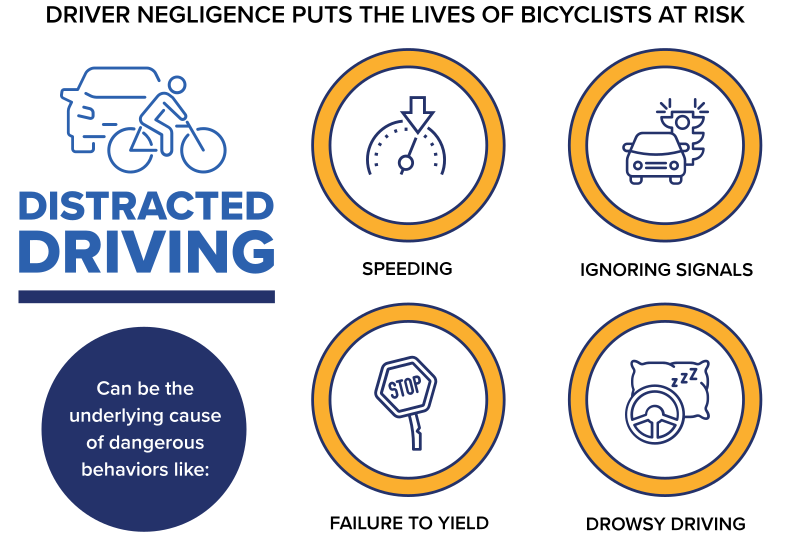
Causes of Bicycle Accidents We Handle
- Who Is Liable in a Chicago Bicycle Accident
- Proving Driver Negligence
- Comparative Fault in Illinois
- Driver Liability
- Employer Liability
- Delivery Company Liability
- Rideshare Company Liability
- Truck Company Liability
- Government Liability for Dangerous Roads
- Filing Claims Against the City of Chicago
- Construction Company Liability
- Property Owner Liability
- Bicycle Manufacturer Liability
- Bicycle Helmet Manufacturer Liability
- Auto Manufacturer Liability
- Multiple Party Liability
- Liability: Dooring by a Parked Car
- Liability: Drivers Failing to Yield
- Liability: Buses and Public Transit
- Liability: Delivery Vehicles
The Briskman Guarantee
Any personal injury consultation is free with Briskman Briskman & Greenberg Personal Injury & Car Accident Lawyers
Chicago's Most Dangerous Roads for Cyclists: Where Accidents Concentrate
Our four-year analysis of City of Chicago crash records identified the specific roads where bike accidents are most frequent, most severe, and most likely to involve a driver who flees. These are not obscure corridors. They are the routes that thousands of Chicagoans ride every day, and the risk levels vary significantly even between roads that appear similar on a map. A full breakdown is available in our published research: Chicago Bike Accidents Have Surged 46% Over Four Years.
N. Milwaukee Ave stands alone as Chicago's most dangerous road for cyclists. The data is not even close. Milwaukee recorded 329 bike accidents over the four-year study period, 253 injuries, and 1 fatality, averaging more than 82 accidents per year. Its diagonal path through Wicker Park, Logan Square, and Avondale creates complex intersection geometry at nearly every block, placing cyclists in repeated conflict with turning vehicles that are not anticipating their presence. N. Clark St ranks second at 274 accidents and 214 injuries. Together, these two corridors account for more than 7% of all bike accidents in Chicago over four years.
The Halsted corridor is Chicago's most dangerous continuous north-south system for cyclists. N. Halsted St and S. Halsted St recorded 165 and 153 accidents respectively over the study period, a combined 318 accidents that places the corridor above every individual road except Milwaukee. Cyclists commuting north to south along Halsted are navigating one of the city's highest-risk environments for a sustained stretch with limited protected infrastructure. N. Damen Ave at 175 accidents is notable because it also recorded a fatality despite lower volume than several higher-count corridors, a reminder that frequency and severity do not always move together.
W. North Ave tells a specific and particularly troubling story about hit-and-run risk. Of 123 bike accidents on North Ave during the study period, 47 involved a driver who fled the scene, a hit-and-run rate of 38.2%, the highest among all high-volume corridors in the dataset. A cyclist struck on North Ave faces nearly a 2-in-5 chance that the driver will not stop. That is not an accident trend. That is an accountability failure at a specific location. Our firm handles cases across all of Chicago's most dangerous corridors, including the resources at Most Dangerous Intersections for Cyclists in Chicago and Most Dangerous Roads for Cyclists in Chicago.
Approximately 53% of all Chicago bike accidents occur on arterial roads, the high-speed, high-volume urban corridors that form the backbone of the city's grid. See our full resource on Chicago Bicycle Accidents on Arterial Roads.
Web Guides
Our web stories cover individual personal injury topics in depth.

Bicycle Accident Injuries and Your Right to Compensation
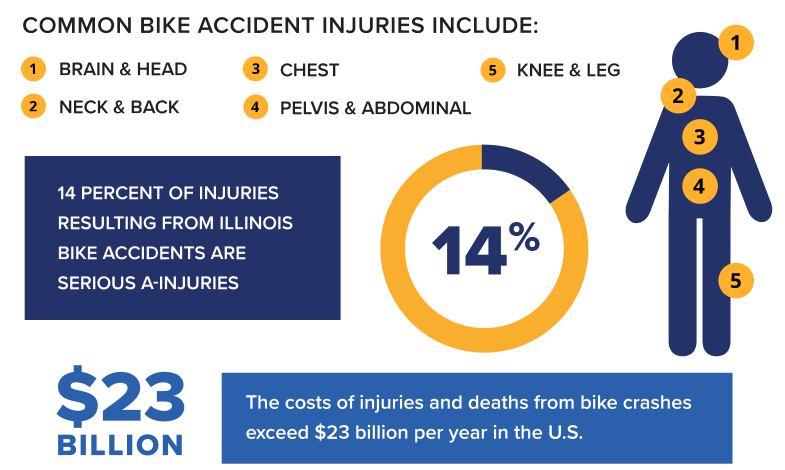
More than 73% of Chicago bike accidents result in some level of injury, and the injury population is growing. Only about 27% of cyclists involved in a reported accident walk away physically unharmed. Our four-year analysis found non-incapacitating injuries, the category covering broken bones, concussions, lacerations, and soft tissue damage serious enough to require medical treatment, grew 39.9% between 2022 and 2025, from 881 incidents to 1,233. This is the fastest-growing injury category in the dataset, and it represents a large and expanding group of cyclists who have been hurt enough to need care, time off work, and in many cases legal representation.
The most severe injuries tend to fall into predictable categories based on accident type. Head and brain injuries are most common in dooring accidents and accidents where the cyclist is thrown over the handlebars. Spinal and back injuries are associated with rear-end collisions and high-speed vehicle impacts. Lower limb fractures, including broken legs and shattered knees, are common in sideswipe accidents and collisions involving large vehicles. Road rash can appear minor but frequently conceals deeper tissue damage and creates significant infection risk. Internal injuries, including organ damage and internal bleeding, are the injuries most often missed in the immediate aftermath of an accident, because they may not produce obvious symptoms until hours later.
The most important thing to know about injuries after a bike accident is that you should seek medical attention before you decide whether you need it. Adrenaline suppresses pain perception. The symptoms of a concussion may not appear for 24 to 72 hours. A cracked rib that feels like a bruise in the moment can become a punctured lung under the right conditions. Going to an emergency room or urgent care immediately after an accident does two things: it protects your health, and it creates a medical record that directly connects your injuries to the accident. If you delay, the insurer for the responsible driver will argue that your injuries must have occurred elsewhere, or must not be as serious as you claim. Do not give them that argument.
Compensation in a bike accident case can cover far more than your hospital bills. Lost income during recovery, the long-term impact on your earning capacity if the injury is permanent, future medical costs including ongoing physical therapy, pain and suffering, emotional distress, scarring and disfigurement, and the cost of replacing your bicycle are all potentially compensable under Illinois law. When a crash is fatal, the family of the cyclist may pursue a wrongful death claim under the Illinois Wrongful Death Act (740 ILCS 180/2), which must be filed within two years of the date of death. We handle the full spectrum of bicycle accident injuries and compensation claims.
- Traumatic Brain Injuries
- Concussions
- Skull Fractures
- Spinal Cord Injuries
- Paralysis
- Herniated Disc Injuries
- Broken Arms
- Broken Legs
- Broken Wrists
- Shoulder Injuries
- Hip Injuries
- Road Rash Injuries
- Lacerations
- Internal Bleeding
- Organ Damage
- Dental Injuries
- Facial Injuries
- Fatal Bicycle Accidents
- Wrongful Death Claims
- How Insurance Works After a Bike Accident
- Filing an Insurance Claim
- Dealing With Insurance Adjusters
- Using Your Own Auto Insurance
- Uninsured Motorist Coverage
- Underinsured Motorist Coverage
- Health Insurance Coverage
- Medical Payments Coverage
- What Damages Are Available
- Medical Expenses
- Future Medical Costs
- Lost Wages
- Loss of Earning Capacity
- Pain and Suffering
- Emotional Distress
- Permanent Disability
- Scarring and Disfigurement
- Bicycle Repair or Replacement
- Wrongful Death Damages
- Settlement Values in Chicago
- Factors That Affect Settlements
- How Long Claims Take to Resolve
- When to File a Lawsuit in Illinois
The Legal Process: What to Expect After a Chicago Bike Accident
What to Do After a Chicago Bike Accident: Step by Step
A police report is foundational evidence. Request emergency services even if you think you are okay. Adrenaline commonly masks pain in the minutes after impact, and a concussion may not present symptoms for hours.
Photograph vehicles, road conditions, signage, your bike, and your injuries from multiple angles. Collect witness contact information. Note nearby security cameras, because footage is often overwritten within 24 to 72 hours.
Internal injuries and TBIs often present no obvious symptoms. A medical record tying your injuries to the accident is critical evidence. Delays in treatment are routinely used by insurers to deny or reduce claims.
Adjusters are trained to minimize your claim. Do not give a recorded statement, do not sign documents, and do not accept any offer before speaking with an attorney. Even casual statements can be used against you.
The earlier you involve an attorney, the better preserved your evidence and the less opportunity the opposing insurer has to build a defense. Free consultation. No fee unless we win.
The moments after a bike accident are disorienting, and the decisions you make in those moments have legal consequences. You are dealing with pain, shock, and possibly an uncooperative driver or a scene where the driver is already gone. Knowing what to do before an accident happens is the best preparation you can have.
Call 911 and stay at the scene. A police report creates an official record that becomes foundational evidence in your claim. The responding officer's observations, the report number, and the documented scene conditions are each valuable. If your injuries allow, give the officer your account of what happened. If the driver fled, describe the vehicle as specifically as possible, including color, make, body style, and direction of travel.
Document everything you can before the scene changes. Take photographs from multiple angles: the vehicles involved, road conditions, traffic signals and signage, your bicycle, skid marks or debris, and your visible injuries. Collect names and contact information from every witness present, and make sure witness information is included in the police report. If nearby businesses have exterior cameras that may have captured the accident, note their locations immediately, because security footage is frequently overwritten within 24 to 72 hours.
Seek medical attention without delay, even if you believe you are not seriously injured. Traumatic brain injuries, internal bleeding, spinal damage, and soft tissue injuries frequently present few or no symptoms in the immediate aftermath of an accident. Getting evaluated immediately protects your health and creates a medical record that connects your injuries to the accident. Insurance companies routinely use delays in medical treatment as grounds to deny or reduce claims.
Do not speak to the at-fault driver's insurance company before consulting an attorney. Adjusters are trained to gather statements that can be used to reduce what you recover. Even an innocent-sounding description of how you feel can become evidence that your injuries are not serious. Do not give a recorded statement, do not sign any documents, and do not accept any offer without legal counsel. Learn more about Dealing With Insurance Adjusters After a Bicycle Crash.
The filing deadline is the most critical legal protection you have to understand. Under 735 ILCS 5/13-202, injured individuals have two years from the date of an accident to file a personal injury lawsuit in Illinois. Miss that deadline and you permanently lose your right to compensation regardless of how strong your case is. If a government entity is involved, including the City of Chicago, CDOT, or the CTA, the Tort Immunity Act (745 ILCS 10/8-101) compresses that window to one year. Our attorneys have seen clients lose valid claims because they did not know this shorter deadline applied to their case. Full details at Illinois Statute of Limitations for Bicycle Accidents.
- What to Do After a Bicycle Accident
- Steps to Take Immediately After a Crash
- When to Call the Police
- How Accident Investigations Work
- Evidence Used in Bicycle Accident Cases
- Using Traffic Camera Footage
- Using Witness Testimony
- How Bicycle Accident Lawsuits Work
- Illinois Statute of Limitations
- How Long Claims Take
- Illinois Bicycle Laws Every Cyclist Should Know
- Bicycle Right-of-Way Laws
- Chicago Bike Lane Laws
- Chicago Bicycle Helmet Laws
- Chicago Bicycle Lighting Laws
- Sidewalk Riding Laws
- Chicago Bicycle Traffic Rules
- Chicago Bicycle Passing Laws
- Illinois Safe Passing Law for Cyclists
- Illinois Bicycle Equipment Laws
- Illinois Bicycle Accident Reporting Laws
Dangerous Locations, High-Risk Cyclists, and Staying Safer on Chicago Roads

Where you ride in Chicago matters enormously. Approximately 53% of all Chicago bike accidents occur on arterial roads, the high-speed, high-volume urban corridors that carry the most traffic. But within that broad category, specific locations carry risk levels that deviate sharply from the average. The lakefront trail carries different risk than the downtown Loop. School zones carry different risk than late-night commercial areas. Understanding where accidents concentrate helps cyclists make better route decisions and helps our attorneys build better cases when something goes wrong.
Accidents near transit stations deserve particular attention because of the density of vehicle movements, cyclists, and pedestrians that converge at these locations. CTA buses pulling in and out, Uber and Lyft vehicles stopping to drop off passengers, and delivery vehicles double-parked create conditions that are among the most unpredictable in the city. We handle Chicago Bicycle Accidents Near Transit Stations, Chicago Bicycle Accidents Near Schools, Chicago Bicycle Accidents Near Parks, and Chicago Bicycle Accidents on Lakefront Trails.
Not all cyclists face the same risks, and legal representation that understands those differences produces better outcomes. Children injured in bicycle accidents involve different legal considerations than adult commuter cases, including questions of contributory negligence, parental consent, and the statute of limitations tolling rules for minors. Senior cyclists face a higher severity of injury for a given impact, making thorough documentation of the injury's impact on daily life more critical in building a claim. Delivery riders face a complex intersection of employment law and personal injury law, particularly when the accident occurs while they are actively working. We represent Children Injured in Bicycle Accidents, Teen Bicycle Accident Injuries, College Student Bicycle Accidents, Commuter Bicycle Accidents in Chicago, Bicycle Accidents Involving Delivery Riders, Bicycle Accidents Involving Tourists in Chicago, and Senior Cyclist Bicycle Accidents.
We believe that helping cyclists stay safer before accidents happen is as important as representing them after. Our resources on bicycle safety cover everything from how to read traffic in Chicago's most challenging intersections to the specific lighting requirements that affect both your safety and your legal claim if you are struck at night. Chicago Bicycle Lighting Laws (Municipal Code 9-52-080) require a front white light and rear red reflector after dark. Cyclists who are struck while riding without required lighting face comparative fault arguments from the opposing insurer. Knowing the rules protects you twice: once on the road, and once in the courtroom.
Injured in a Chicago Bike Accident? Our Attorneys Are Ready
Briskman Briskman & Greenberg
Chicago is failing its cyclists. We make sure it does not fail you twice.
The accidents in our research involve specific, identifiable driver behaviors: failing to yield, running red lights and stop signs, illegal passing, and fleeing the scene. Each constitutes negligence under Illinois law, and negligence is the foundation of your personal injury claim. You have legal rights that deserve protection, even if the driver fled.
Our attorneys have spent decades fighting for injured Chicagoans. If a negligent driver caused your accident, we can investigate the incident, identify all liable parties, deal with insurance companies on your behalf, and pursue the full compensation you deserve: medical bills, lost wages, pain and suffering, and more. There is no fee unless we win your case.
Frequently Asked Questions About Chicago Bike Accident Attorneys





SEEN ON:







